The history behind the story
One aircraft. Thousands of pages of history.
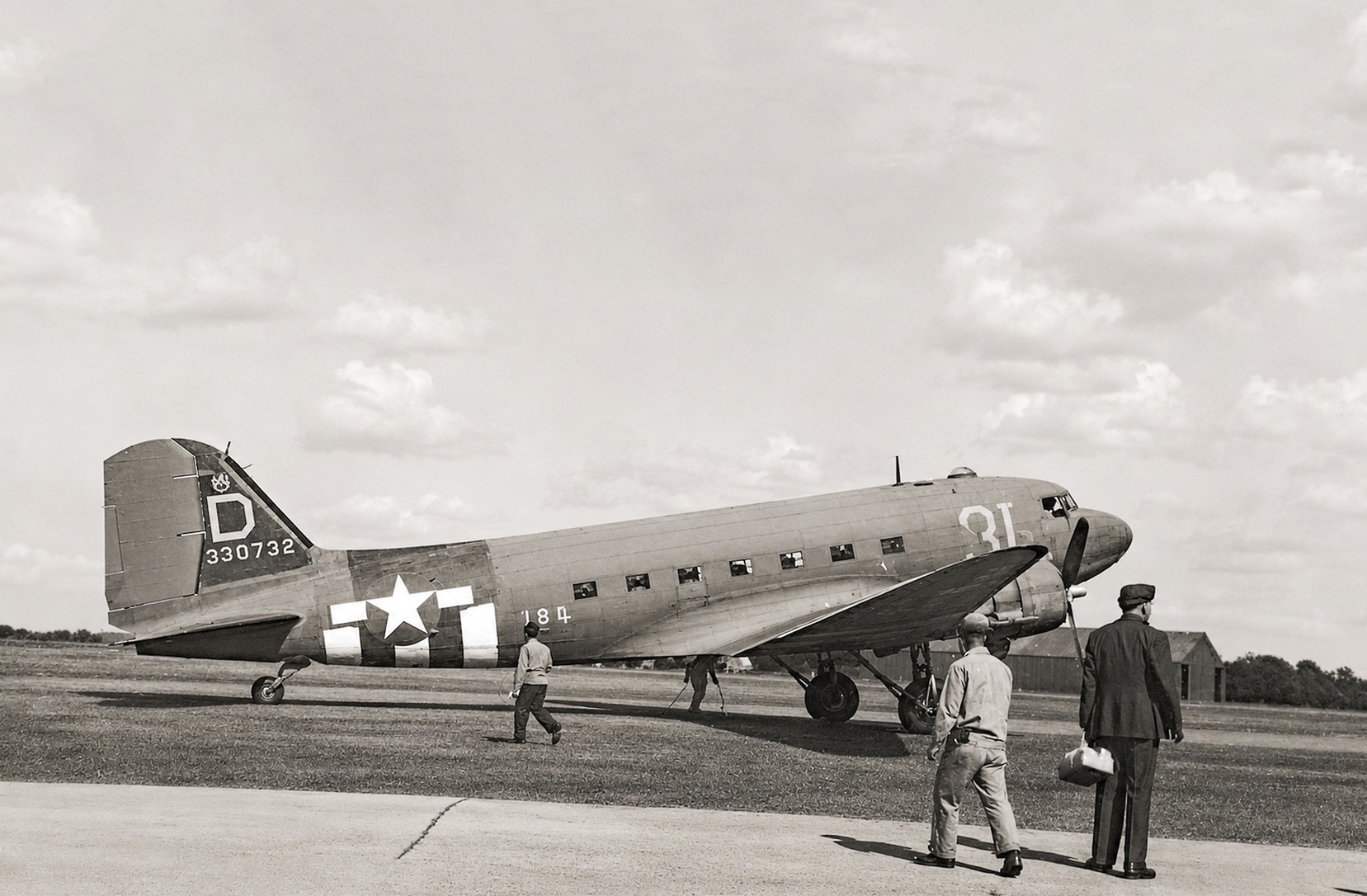
Daisy was delivered as a military transport aircraft in 1943. To trace her missions, Tomas Rinman searched the war diaries held by the Air Force Historical Research Agency, AFHRA, at Maxwell Air Force Base in the USA.
The material runs to more than 10,000 pages, preserved on microfilm and later scanned. As searching by serial number did not work, the pages had to be reviewed by hand. Daisy can be identified by the last digits of her serial number: 732.
This story is based on Rinman's article and the accompanying flight list. The name Daisy is used for the war years too, even though she only received it in 1985. Unit totals should not be confused with Daisy's own flights.
October–November 1943
From Long Beach to North Africa
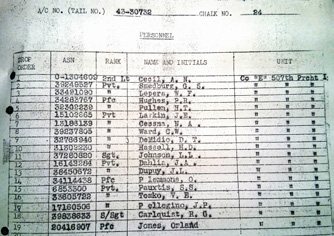
On 5 October 1943, Daisy was delivered at the Douglas factory in Long Beach, California, as a C-47A – the military version of the DC-3. Her military serial number was 43-30732. The aircraft was sent to Baer Air Force Base in Indiana for tests and inspections.
Extra fuel tanks were fitted in the cabin ahead of the long journey to North Africa. The route went via Florida, Puerto Rico, Trinidad, Georgetown, Belém, Natal, Ascension in the southern Atlantic, Dakar, Agadir and Marrakesh to Oran in Algeria. According to the article, Daisy arrived on 20 November 1943.
December 1943
Troops, equipment and wounded soldiers
Daisy transported troops, equipment and wounded soldiers in North Africa. Details of these flights are missing from the war diaries. She was initially based in Oran and later moved to Sciaccia on Sicily.
February 1944
A new base in England
Daisy now belonged to 12th Air Force, 61st Troop Carrier Group and 14th TCS. As the need for C-47s in North Africa declined and planning for D-Day gathered pace, large numbers of aircraft were transferred to England via Morocco.
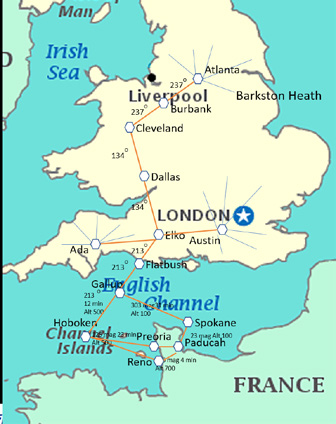
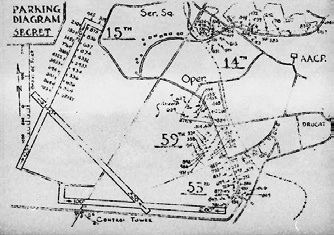
Daisy was part of an armada of around 250 C-47s that flew to St Mawgan in England and then on to Barkston Heath. The flight list records Morocco–St Mawgan on 17 February and arrival at Barkston Heath on 18 February. Here began months of preparations for the invasion. The ground crews travelled from Italy to England by train, lorry and ship.
March–May 1944
Months of preparation
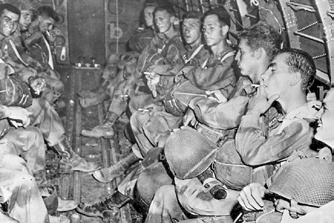
March was devoted to parachute drops, glider towing and formation flying. Exercises continued in April, now also including formation flying at night and transport flights within England.
Training intensified during May. Paratroopers and gliders took part in increasingly large exercises, alongside transport exercises involving many C-47s. The flight list mentions Mission Eagle on 11 May, among others.
5–6 June 1944
Daisy on D-Day
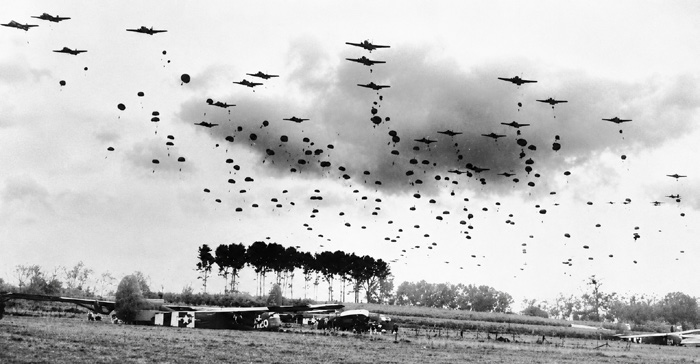
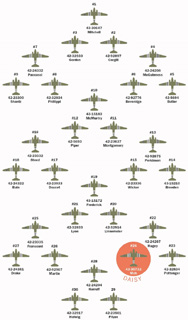
Daisy took part in Mission Boston, a parachute assault by the American 82nd Airborne Division. The mission involved ten formations comprising around 800 C-47s, from which a total of 6 420 paratroopers jumped. These figures cover the entire mission, not just Daisy.
At 23.00 on 5 June, Daisy took off from Barkston Heath. She was to drop her paratroopers over Drop Zone T in Normandy. According to the article, she reached the target at 02.32 on 6 June.
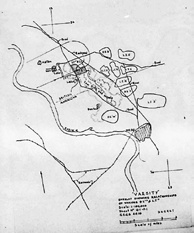
The soldiers jumped over an area of around ten square kilometres near the River Merderet. The Germans had dammed the river and flooded the area. Many of those who jumped that morning drowned in the flooded fields under the weight of their heavy equipment.
After D-Day, Daisy flew transport missions to and from Normandy and continued training in England. The flight list also records that she was hit by a lorry at Sainte-Mère-Église on 23 June, damaging her aileron. The return flight after repairs is given an uncertain date: 25 June 1944?
July–August 1944
Transport flights across the Channel
Daisy took part in several exercises and transport flights during July. In August, she flew to continental Europe and within Great Britain while training continued. The flight list records casualty evacuations, freight missions, passenger transport and mail deliveries, among other flights.
September 1944
Operation Market Garden
Daisy was involved from the very first day of the main assault, 17 September. She dropped British paratroopers at Oosterbeek in Arnhem ahead of the assault on the bridge over the Rhine. On 23 September, she towed a glider to the landing zone at Grave near Nijmegen to reinforce the troops at the bridges over the Maas and Waal.
Over four days in September, the unit to which Daisy belonged flew more than 229 missions. 900 tonnes of cargo were delivered and 2 372 soldiers parachuted in or were transported by glider. Six C-47s were lost, 25 were damaged and 33 people were killed. The article states that Daisy was probably among the damaged aircraft, but this is uncertain.
For September, the article also records 570 transport aircraft sent to the continent, 722 passengers and 195 wounded people evacuated. Nearly 100 tonnes of equipment were delivered and 1 202 277 litres of petrol were consumed. These totals apply to the organisation.
October 1944
A new crew, continued service
According to the article, Daisy was now transferred to 53rd TCS and assigned a new crew. Rain, fog and low cloud made it a difficult month, but deliveries of winter equipment to France, the Netherlands and Germany continued.
The organisation deployed 909 aircraft on 45 missions and delivered more than 200 tonnes of equipment. On the return flights, 64 wounded soldiers were brought back. The article records a total of 6 976 flying hours and 2 155 080 litres of petrol consumed.
November 1944
Vital deliveries
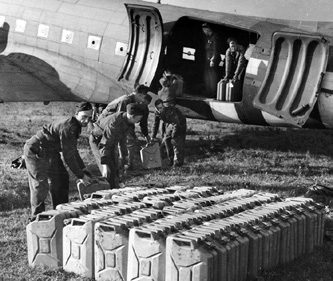
During November, nearly 2 000 tonnes of equipment were delivered to the continent. The cargo included petrol, ammunition, glycol, penicillin, blood plasma and steel matting for airfields. The flight list records Daisy's many deliveries and preparatory flights to collect cargo.
December 1944
Winter and the Battle of the Ardennes
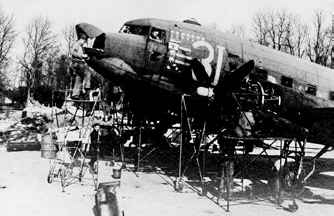
A thin blanket of snow lay over Barkston Heath on Christmas Eve. Daisy flew supplies to those fighting at Bastogne during the Battle of the Ardennes. The article mentions landings at Prosnes and Laon in December; the flight list records both deliveries and return flights carrying wounded soldiers.
Daisy's organisation, 61st TCG, carried more than 100 tonnes of equipment to the continent. The group flew a total of 4 724 hours and consumed 390 406 gallons of petrol. Eleven men were killed and two were injured.
January 1945
Flying in harsh winter weather
Snowstorms, thick fog and torrential rain reduced flying activity. 61st TCG delivered 34 tonnes of equipment, mainly skis, snowshoes and winter clothing. The C-47s flew a total of 3 163 hours. 47 people were transported and 94 wounded soldiers were evacuated from the continent.
February 1945
Preparing for France
The organisation deployed 686 aircraft, transported 578 600 gallons of petrol and delivered 1 313 tonnes of equipment. 2 946 passengers and 197 patients were carried during 6 596 flying hours. Meanwhile, preparations were made to move 61st TCG to France. Between transport missions, crews practised formation flying and glider towing.
March 1945
Abbeville and Operation Varsity
March was the organisation's busiest month so far. Barkston Heath came under air attack for the first time. At the beginning of the month, the organisation moved to Abbeville in France, the American airbase B-92. Most of the move was carried out by air, while heavy equipment was transported by lorry and ship.
On 24 March, Daisy took part in Operation Varsity. British paratroopers jumped onto the eastern bank of the Rhine to support Montgomery's crossing of the river. With more than 16 000 paratroopers and several thousand aircraft, Varsity is described in the article as the largest airborne operation carried out in a single day at one location. The flight list notes that Daisy returned with a para-rack that had not been released.
For March, the organisation records 1 662 active aircraft: 672 on combat missions, 391 on training flights and 599 delivering supplies to combat units. Around 2 000 tonnes of supplies, 791 passengers, 1 486 paratroopers and 1 524 other soldiers were transported. Flying time totalled 5 794 hours.
On 31 March, Daisy flew petrol to General Patton's army along the route Abbeville–Coulommiers–Frankfurt–Abbeville, according to the flight list. The article records 306 100 gallons of 80-octane petrol for the combined transport effort supplying the advancing ground troops.
April 1945
Prisoners of war return home
Daisy's squadron transported more than 454 tonnes of equipment to Germany. Prisoners of war could be flown back to France and Belgium. The squadron also operated as a military airline for American soldiers on leave to the Riviera. The flight list records Daisy's transport of French prisoners of war and notes that all 20 C-47s returned to Barkston Heath on 30 April.
May–October 1945
The end of the war and the return journey
On 8 May, Nazi Germany surrendered unconditionally. The day is celebrated as VE Day, Victory in Europe Day. The flight list states that Daisy left Barkston Heath for Trinidad on 14 May and landed there on 16 May; the full route has not yet been found.
On 23 September, she returned to the USA, flying from Trinidad to Morrison in Florida. The flight list then records Morrison–Bush Field in Georgia on 24 October, en route to the Reconstruction Finance Corporation, RFC. This US government organisation sold off surplus military equipment.
1946 onwards
From C-47 to Nordfugl
During 1946, Canada Air Ltd in Montreal converted Daisy from a military C-47 into a civilian DC-3C. The large cargo doors were replaced by a standard passenger door. The cabin was soundproofed and fitted with more comfortable seats.
After the conversion, she was sold to Det Norske Luftfartselskap, DNL. In Norway, she received the registration LN-IAF and the name Nordfugl. The aircraft was not named Daisy until 1985 – Tomas Rinman's article also uses this name for the war years to simplify the story.
The people on board
Daisy's crews
Spring and summer 1944
- Norbert D. Moh
- Pilot
- Charles M. Adamson
- Co-pilot, spring 1944
- Ernest M. Martzen
- Co-pilot, summer and autumn 1944
- Edsel C. Linn
- Navigator
- William H. Gray
- Crew chief
- Arvid J. Blomdal
- Radio operator
From October 1944
- John F. Drylo
- Pilot
- Joseph J. Bowling
- Co-pilot
- Henry Henson
- Mechanic
- William R. Johnston
- Radio operator
Norbert D. Moh was in command during the spring, summer and autumn of 1944. In November and December he served with the Pathfinder Group at Chalgrove. By January 1945 he had completed his tour of duty and was transferred to the “Zone of Interior”.